How to choose
How to tell whether a $140 moisturiser is worth it to you
Price per jar hides the number that matters. At 0.5 mL twice a day a 50 mL jar lasts 50 days, so a $140 jar costs $1.40 a use and $1,022 a year.
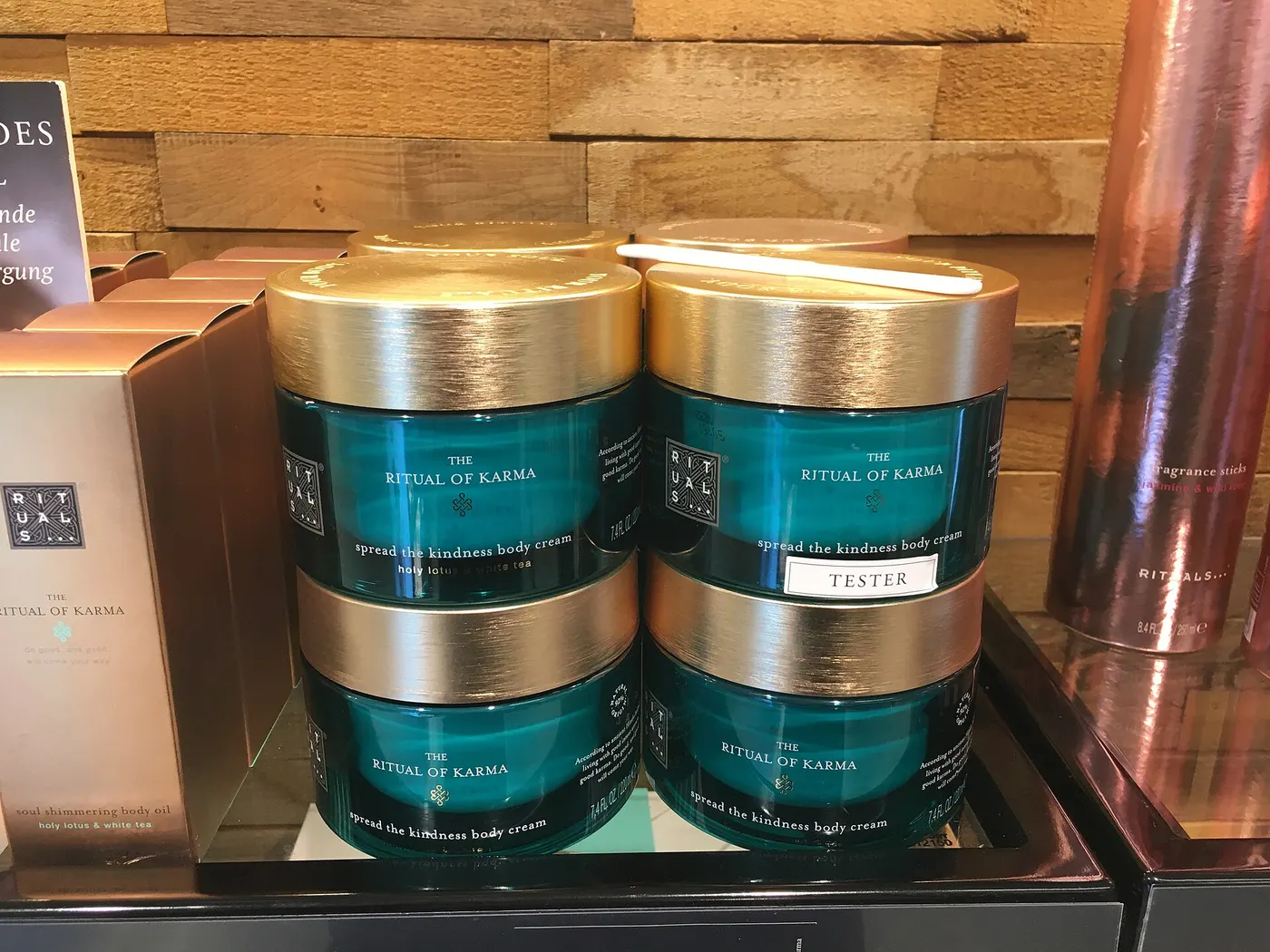
Premium skincare is sold by the jar and used by the millilitre, and the gap between those two units is where most buying decisions go wrong. A jar that costs three and a half times as much does not last three and a half times as long; it lasts exactly as long as any other jar of the same volume used the same way.
This guide converts shelf prices into the number you actually spend, then sets out the four questions that decide whether the higher figure is defensible for you. Every price is an example checked on 2026-11-03, not a quoted price. This site has no price feed, no ratings and nothing for sale.
Turn the jar price into a cost per use
Start with the dose. A face and neck application of moisturiser is roughly 0.5 mL, which means a 50 mL jar yields about 100 applications. At twice a day that jar lasts 50 days, so a year of continuous use takes 7.3 jars.
Run that through two prices. A $40 jar is $0.40 an application and $292 a year. A $140 jar is $1.40 an application and $1,022 a year. The difference is $730 a year for the same volume applied the same way, and it is invisible when you are comparing two jars on a shelf.
Do the same for every other step before you decide anything. A 30 mL serum at 0.3 mL once a day also gives 100 applications, so it lasts 100 days and takes 3.65 bottles a year. At $150 a bottle that is $1.50 a use and $548 a year. The cost-per-use calculator on this site takes your own pack size, dose and frequency.
| Product | Pack | Dose and frequency | Uses per pack | Price | Per use | Per year |
|---|---|---|---|---|---|---|
| Cleanser | 200 mL | 2 mL, twice a day | 100 | $55 | $0.55 | $402 |
| Serum | 30 mL | 0.3 mL, once a day | 100 | $150 | $1.50 | $548 |
| Moisturiser | 50 mL | 0.5 mL, twice a day | 100 | $140 | $1.40 | $1,022 |
| Moisturiser, cheaper | 50 mL | 0.5 mL, twice a day | 100 | $40 | $0.40 | $292 |
Annual figures are uses per year divided by uses per pack, times the price: 7.3 packs a year for the twice-daily products and 3.65 for the once-daily serum. These are worked examples, not offers.
The pack format changes the figure before the formula does
A wide-mouth jar leaves product on the walls and under the lid. If 5% of a 50 mL jar never reaches your face, you have 95 applications rather than 100, and the $140 jar moves from $1.40 to $1.47 a use. That is a 5% price rise created entirely by the container.
An airless pump wastes less and doses more consistently, which matters because dose drift is the other half of this arithmetic. Someone using 0.7 mL instead of 0.5 mL gets 71 applications from a 50 mL jar rather than 100, and the $140 jar becomes $1.97 a use and $1,438 a year without anyone deciding anything.
Weigh the jar on kitchen scales when it arrives and again when you think it is empty if you want your own figure rather than this one. The difference between the assumed dose and the real one is usually larger than the difference between two brands.
- 50 mL at 0.5 mL a time: 100 applications, 50 days at twice daily
- 50 mL at 0.7 mL a time: 71 applications, 36 days at twice daily
- Residue of 5% in a jar raises a $1.40 application to $1.47
- A drift from 0.5 mL to 0.7 mL raises the same application to $1.97
- The annual cost of that drift on a $140 jar is $416
The four questions that decide the premium
First, is the expensive product replacing a step or adding one. A $150 serum that lets you drop a $55 cleanser changes the annual total by $146 rather than $548. A serum added on top of everything else changes it by the full $548.
Second, will you finish it. A product used for 6 weeks and abandoned has a cost per use set by the fraction you used, not by the pack. Half a $140 jar discarded is $2.80 for each of the 50 applications you actually made.
Third, does the format suit the way you use it, which is the jar-versus-pump arithmetic above. Fourth, can your skin tolerate it, which no price settles and which a patch test over 5 days answers before a full jar is opened. Those four together explain most of the difference between a premium purchase that is repeated and one that is not.
| Situation | Annual difference | The premium is defensible when |
|---|---|---|
| $140 jar replaces a $40 jar | $730 more | You finish every jar and tolerate it |
| $150 serum added to the routine | $548 more | No existing step is doing the same job |
| $150 serum replaces a $55 cleanser step | $146 more | The routine gets shorter, not longer |
| Half the premium jar is abandoned | $2.80 per use made | It does not, on any reading |
All four rows use the same dose and frequency assumptions as the first table, so they can be compared directly.
What the price tag is and is not evidence of
In Australia the ingredients on a cosmetic label are governed by a Consumer Goods Information Standard listed on the Federal Register of Legislation, whose sections are headed 'List of ingredients' and 'Form of ingredients list'. That standard governs how the list is presented; it does not require a concentration to be published, so two products with identical-looking lists can differ by an order of magnitude in how much of the named ingredient is present.
The ingredients themselves are regulated upstream rather than at the shelf. The Industrial Chemicals Act 2019 establishes the Australian Industrial Chemicals Introduction Scheme and requires that introductions be authorised, through listed, exempted, reported, assessed, commercial evaluation or exceptional circumstances pathways. That is a scheme about importing and manufacturing chemicals, not a ranking of products.
So a high price is evidence about packaging, distribution and positioning, and is not evidence about concentration. The only figures a buyer can verify at the point of sale are the pack size, the price and their own dose, which is exactly the arithmetic in the first table.
Before you buy
- Write down the pack size in millilitres and your real dose per application
- Divide pack size by dose to get applications per pack
- Divide the price by applications to get cost per use
- Multiply by your yearly application count to get the annual figure
- Repeat for the cheaper alternative before comparing shelf prices
- Weigh the jar after 14 days to replace the assumed dose with your own
- Patch test over 5 days before opening a full-size premium jar
Questions readers ask
- How much moisturiser is one application?
- This guide uses 0.5 mL for face and neck, which gives 100 applications from a 50 mL jar. Your own figure is easy to check: weigh the jar on kitchen scales, use it for 14 days at your normal rate, and weigh it again. One gram is close enough to one millilitre for this purpose, and the result replaces every assumption above.
- Does a larger pack always cost less per use?
- Only if the price per millilitre falls and you finish it before it changes. A 100 mL jar at $240 is $1.20 a use against $1.40 for the 50 mL jar at $140, a saving of $146 a year. If the larger jar sits open for 100 days instead of 50, that saving is competing against whatever the extra open time costs the formula.
- Is a jar or a pump better value?
- A pump, on the arithmetic. A jar that leaves 5% behind turns 100 applications into 95 and raises a $140 jar from $1.40 to $1.47 a use, which is $73 a year. The pump also holds the dose steadier, and dose drift from 0.5 mL to 0.7 mL costs $416 a year on the same jar.
- Should I buy the premium product in a travel size first?
- It is the cheapest way to answer the tolerance question before committing $140. A 15 mL travel size at 0.5 mL twice a day lasts 15 days, which is long enough to see whether you will finish a full jar. Travel sizes usually cost more per millilitre, and that premium is the price of not abandoning a large jar.
- Does an expensive product need less of it?
- The pack does not say so, and the ingredient list is not required to carry a concentration, so there is no published figure to compare. If you do use less, the arithmetic rewards you directly: 0.3 mL twice a day from a 50 mL jar gives 83 applications instead of 100, which takes a $140 jar from $1.40 to $1.69 a use.
Sources
- Federal Register of Legislation — Consumer Goods (Cosmetics) Information Standard 2020, sections headed 'List of ingredients' and 'Form of ingredients list' — checked 2026-11-03
- Federal Register of Legislation — Industrial Chemicals Act 2019, establishing the Australian Industrial Chemicals Introduction Scheme and requiring introductions to be authorised — checked 2026-11-03
- Consumer Affairs Victoria — consumer guarantees that apply automatically, including the $100,000 consumer threshold — checked 2026-11-03
Some links on this site can earn us a commission. That does not change which product a guide recommends, and it adds nothing to your price. Advertising is not enabled on this site yet. When it is, ads will be labelled and kept visually separate from the guides.